High-Level AI Strategy into a Prioritized Investment Roadmap

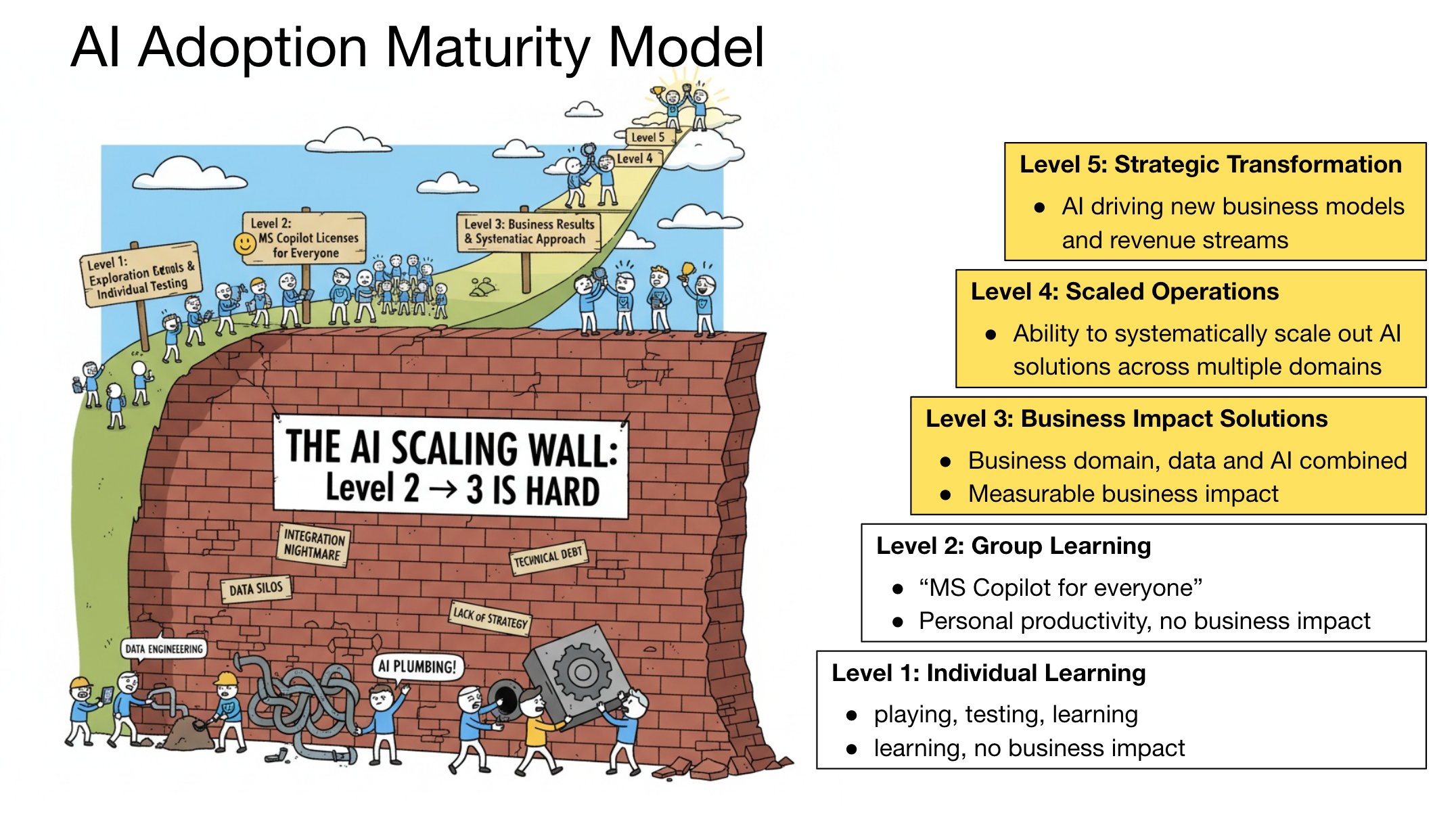
Most enterprises today have successfully reached "Level 2" of AI maturity. You have a high-level AI strategy statement, and you have deployed Microsoft Copilot licenses to your workforce.
But if you look closely at the results, you are likely facing a hard reality: Strategic clarity is missing.
While individual employees are "playing and testing" with tools, the organization is hitting the AI Scaling Wall. You have high-level ambition, but you lack a concrete mechanism to decide which specific AI initiatives will deliver actual business value. The transition from Level 2 (Group Learning) to Level 3 (Business Impact Solutions) is where most companies stall.
The Missing Link: Standardized Investment EvaluationLink to The Missing Link: Standardized Investment Evaluation
Successful AI transformation requires three things: a business problem worth solving, data readiness (the "plumbing"), and architectural expertise. But before you can build capabilities, you must answer the fundamental question: What exactly should we invest in?
Senior leaders are often presented with dozens of potential use cases, ranging from customer service automation to complex predictive maintenance. The challenge isn't a lack of ideas; it is the risk of misallocation. Without a standardized framework, decisions are made based on intuition or "shiny object" syndrome rather than a factual analysis of value versus feasibility.
"What's the business case for AI beyond cost reduction?"
"How do we prioritize among dozens of potential AI use cases?"
"How do we separate AI hype from genuine business opportunities?" "Which AI initiatives will actually move the needle on our key business metrics?"
"Where should we invest our limited AI budget for maximum ROI?"
You need a way to move from "We could do this" to "We should do this because it aligns with our strategic priorities and outperforms the alternatives."
The Solution: APEX Framework for Strategic ClarityLink to The Solution: APEX Framework for Strategic Clarity
To solve this paralysis, we use the APEX Framework. It is designed to take a messy backlog of AI ideas and turn them into a clear, prioritized investment roadmap.
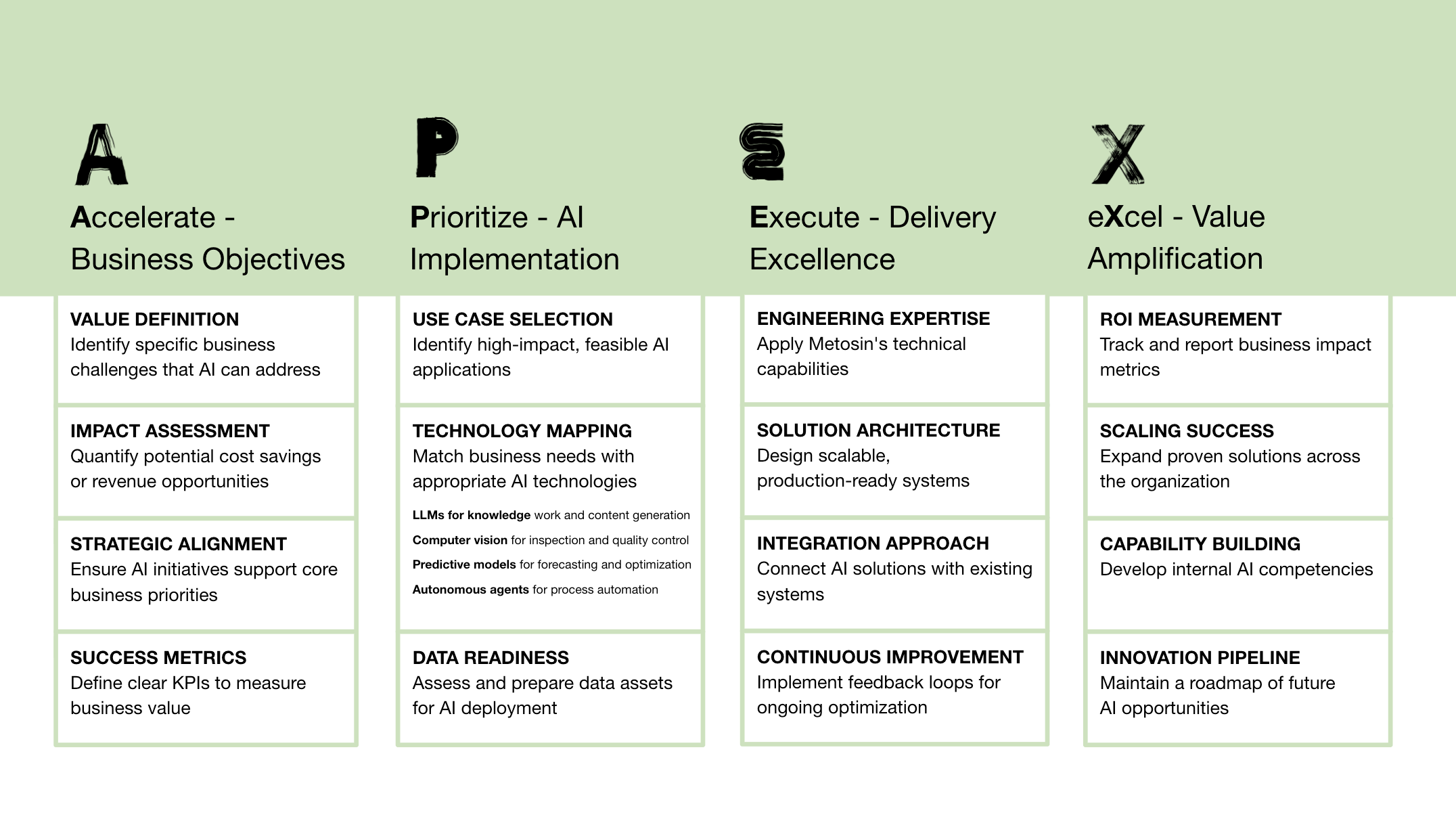
Here is how we evaluate the strategic viability of an AI investment:
A - ACCELERATE (Business Objectives) We stop starting with technology ("What can we do with this LLM?") and start with value definition.
- Value Definition: We identify specific business challenges and quantify the potential financial impact, meaning cost savings or revenue growth.
- Strategic Alignment: We rigorously ask, if this initiative supports our core business priorities. If the answer is vague, the initiative is deprioritized.
P - PRIORITIZE (Feasibility & Reality) High business value means nothing if the execution is impossible. We filter ideas through the lens of reality.
- Technology Mapping: We match the business need with the appropriate AI technology, whether that is Computer Vision, LLMs, or predictive models.
- Data Readiness: We assess if the necessary data assets are actually available and ready for deployment. This separates the "quick wins" from the "integration nightmares."
E - EXECUTE (Delivery Excellence) While this phase focuses on engineering, for an investment decision, we must define the approach.
- Solution Architecture: We outline a realistic path to a production-ready system, not just a demo.
- Integration Approach: We determine how the solution connects with existing legacy systems, which is often the biggest hidden cost.
X - EXCEL (Value Amplification) We define success before we spend a Euro.
- ROI Measurement: We define clear KPIs to track and report business impact metrics.
- Scaling Success: We evaluate if the solution can be expanded across the organization or if it is a dead-end one-off.
From Intuition to Informed DecisionsLink to From Intuition to Informed Decisions
When you apply this framework, you change the conversation in the boardroom. You stop asking "Is AI a good idea?" and start asking "Which of these 20 initiatives creates the most competitive advantage given our current constraints?".
You move from a list of experiments to a standardized and evaluation model where every investment proposal is comparable, data-driven, and strategically aligned.
Take the Step from Level 2 to Level 3Link to Take the Step from Level 2 to Level 3
If your organization is flush with Copilot licenses but starving for strategic direction, it is time to evaluate your portfolio.
The Next Step: We can help you turn your list of potential use cases into a decision-ready roadmap. In our APEX Framework Workshop, we work with your leadership team to classify your current initiatives, validate the business cases, and identify your high-impact "quick wins."
Let's ensure your AI budget delivers business results, not just technical experiments.


